Inside my latest AI Strategy Day for a forward-thinking international school
Roll back three years, and I was welcoming educators from across the Association of International Malaysian Schools (AIMS) network for a full-day workshop exploring tech integration and the then-emerging world of AI.
Fast-forward to today, and the AI landscape looks vastly different. The initial wave of novel tools has given way to a need for clear, sustainable strategy with a strong focus on AI literacy among students - precisely what brought me to Prince of Wales Island International School (POWIIS) in Penang last week.
Returning to work with some of those same guests from three years ago, the focus had shifted from a simple curiosity to meaningful implementation and building a practical, long-term AI strategy that directly enhances teaching and learning across their campus.
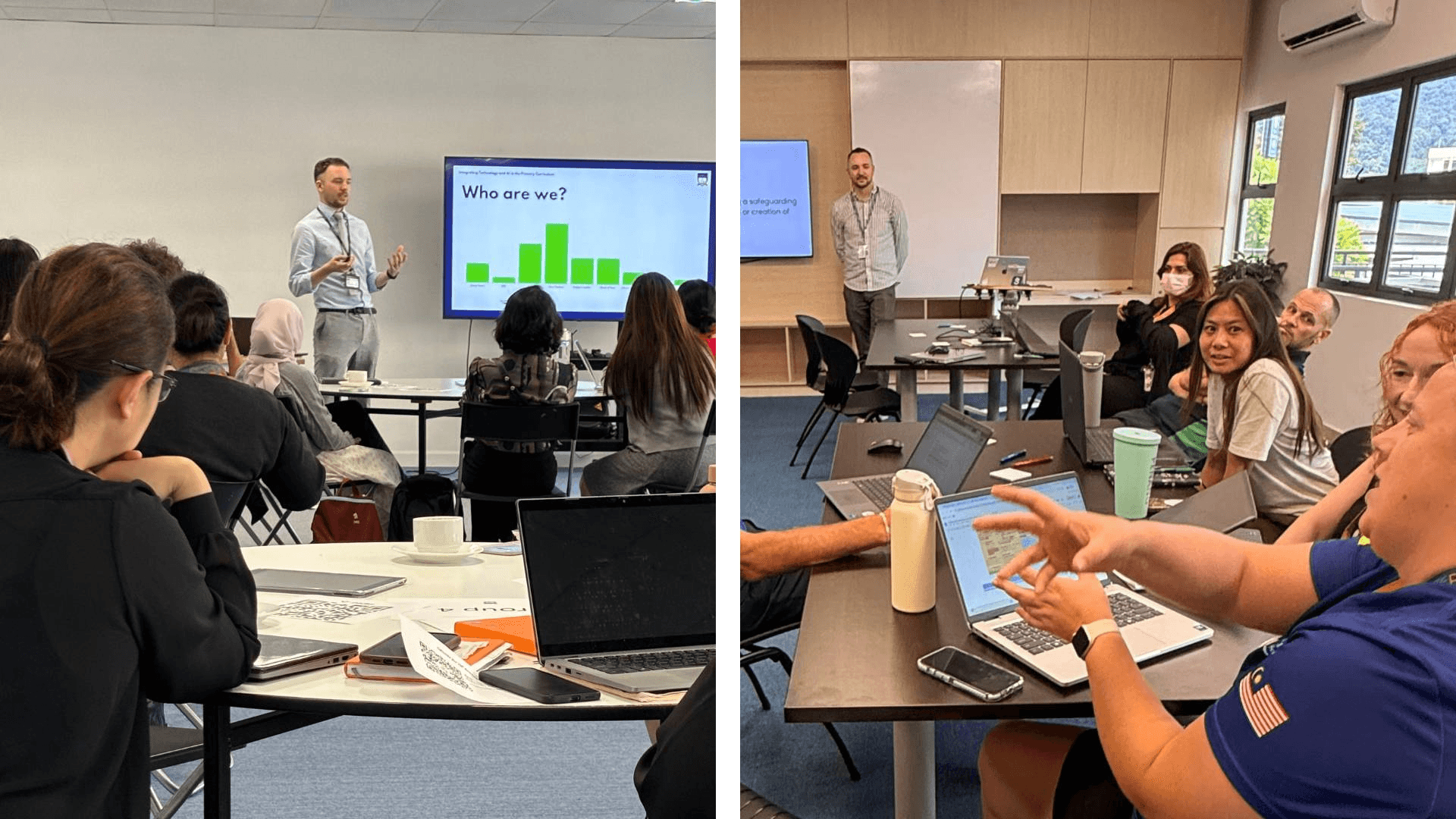
To support the school in developing a clear, encompassing AI philosophy, we focused the day around key areas that every school needs to address now more than ever:
Safeguarding
As we got started for the day, I shared headlines I had read that very morning coming out of the US: schools and districts are banning the use of generative AI tools for students. These recent developments accurately reflect an evolving picture globally - leaders and policy-makers are moving beyond the initial excitement and novelty of AI tools to weigh their capabilities and dangers against a vital question: In an era of rapid technological change, how do we ensure the safety and wellbeing of our young learners?
We also discussed the Department for Education's updated Keeping Children Safe in Education 2026 guidance, which now explicitly mentions companion chatbots and deepfakes as part of a host of new guidance on the use of AI for teachers and students. At this point, I highlighted the DfE's Generative AI Product Safety Standards and we explored how schools can meet similar data protection requirements by implementing strict app review processes.
Looking ahead, it is clear that navigating AI is becoming a core educational requirement around the world. The new National Curriculum in England for 2028 will also reflect this shift, mandating that primary-aged children learn vital skills for spotting fake news and identifying misinformation to proactively protect themselves from digital harms.
Resilience & wellbeing
One of the core focuses for the day's sessions was developing an overarching philosophy and long-term strategy around AI use in the school. We explored a wide range of potential concerns: fragmented attention spans, inappropriate AI-generated content (including student creation as well as exposure), the demand for instant gratification, and the growing risk of digital dependency and over-reliance. A large portion of this deep and broad conversation centred around the concept of 'productive struggle', the learning sweet spot that sits between 'destructive struggle' (a complete mismatch between task and ability) and the detrimental cognitive offloading that leads to an over-reliance on AI tools.
Key teacher tools
Our afternoon sessions transitioned to powerful teacher-facing tools designed to increase admin efficiency and build interactive resources that boost student engagement, monitor progress, and consolidate understanding. Among the platforms we explored were Gemini Notebook (formerly NotebookLM), Canva Code, Google Vids, and AI Studio. Each tool gave teachers a practical way to build a shared library of custom resources for the week ahead, ranging from interactive classroom games and infographics to self-grading formative quizzes and historical roleplay.
AI literacy for students
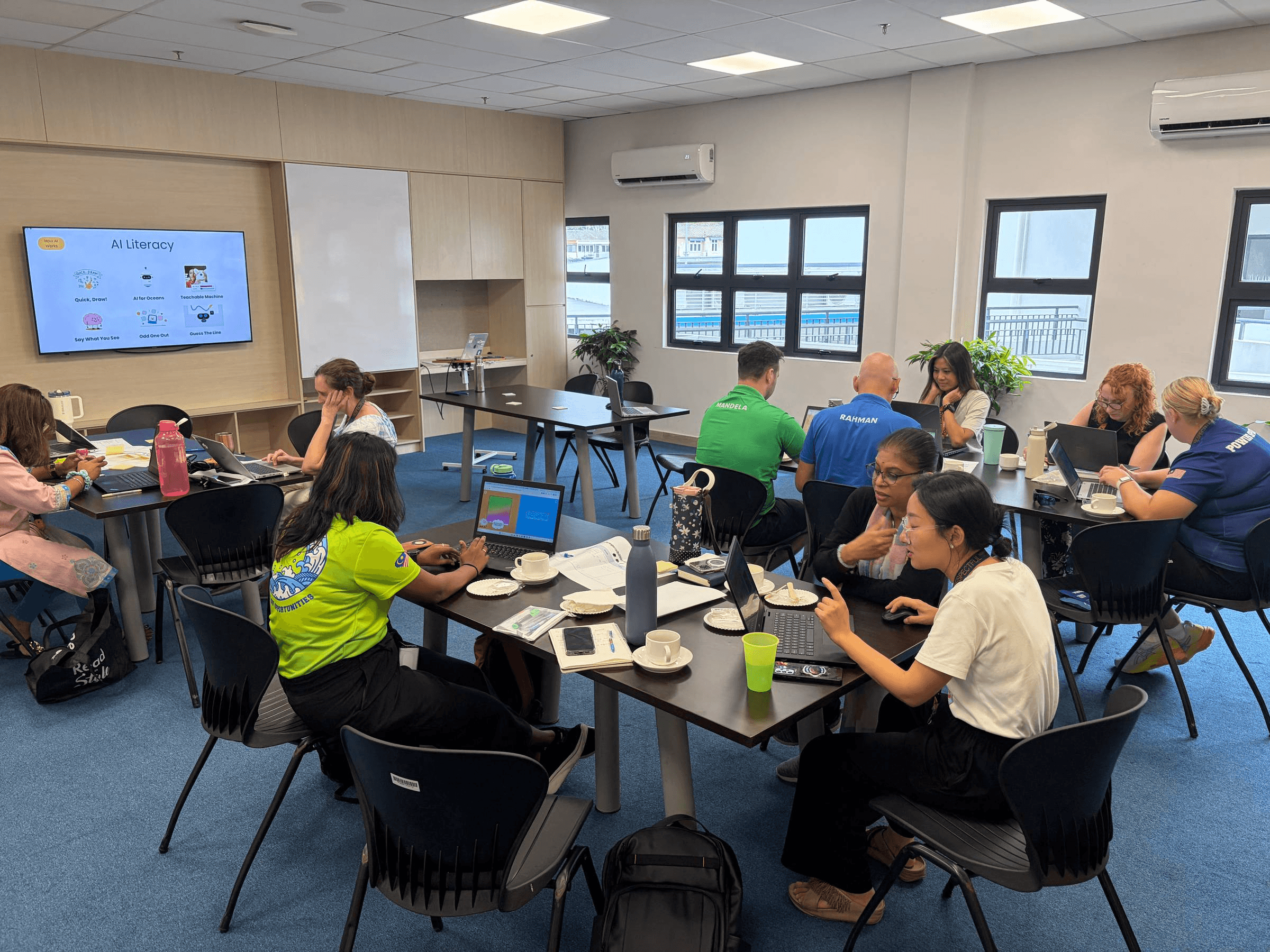
Building on our earlier safeguarding conversations, we explored what AI literacy might look like for primary-aged students. Several globally recognised frameworks, including those from UNESCO, the OECD, and ISTE (alongside emerging government guidance) emphasise that AI literacy must focus on three main themes: developing a strong conceptual understanding of how AI works, encouraging responsible use, and fostering critical judgment of its outputs. To help demystify the technology at a foundational level, we experimented with six engaging tools designed to give young learners a hands-on feel for how machine learning and pattern recognition actually work:
Quick, Draw!
AI for Oceans
Teachable Machine
Say What You See
Odd One Out
Guess the Line
Prompt engineering
As we returned to reflect on our own professional use of AI tools, I steered back round to the art of prompt engineering: structuring instructions to guide generative models toward precise, useful outputs. Moving beyond basic queries requires being specific with language and boundaries, providing rich context and background information, and assigning clear roles to shape the AI's perspective. It also involves explicitly defining the target audience and output format, showing examples to set the right tone, guiding the model's reasoning step-by-step, and iterating or asking the tool for help when refining results.
To put these strategies into practice, teachers engaged in a hands-on activity where they leveraged this range of techniques across various AI tools. By carefully refining their prompts, staff successfully generated strong, highly accurate teaching resources.
Critical judgement
As the day came to a close, it was time to tackle a vital capability for both educators and students: critical judgement. Because generative AI predicts patterns rather than verifying facts, it frequently hallucinates with total confidence. To bring this home, I ran a "spot the fake" activity challenging teachers to critically analyse three historical text outputs and three historical images, separating genuine history from subtle AI fabrications.
The exercise highlighted the essential skills we all need when interacting with AI. For the text outputs, teachers were encouraged to look out for chronological timeline mismatches and flawed geographic reasoning. We also discussed the importance of source verification through lateral reading, opening independent browser tabs to check primary sources, and recognising prompt sensitivity to avoid leading the AI into confirming false premises.
For images, teachers locked into telltale AI artefacts, from distorted anatomy and nonsense background text to inconsistent lighting, warped lines, and overly smooth textures. Ultimately, this ending to our session reinforced a core takeaway: AI tools are only truly useful when we approach them with a sharp, critical eye and an existing foundation of knowledge.
Final thoughts
We now find ourselves in the midst of a shifting culture around student safety and wellbeing in regards to AI, moving past the initial rush of technological novelty into a space where the real dangers and pitfalls of generative AI are receiving the scrutiny they deserve. Whether it is protecting student digital footprints, managing the cognitive risks of over-reliance, or teaching children how to look past a convincing facade, the responsibility falls on us as educators. By staying mindful of these inherent risks and guiding our students with care, we can ensure they navigate this exciting yet complex digital world safely, critically, and with confidence.
"The sessions gave us something we really needed — a clearer sense of direction around AI as a school, while still giving individual staff practical tools they could start using straight away. Hearing what other schools are doing, alongside the clear guidance and hands-on support, made the whole thing feel realistic and achievable rather than overwhelming.
Steve was approachable, knowledgeable and really good at meeting people where they were, regardless of their confidence with AI. His expertise came through not just in his knowledge of the tools, but in his understanding of how AI is actually being used in schools, which made the guidance feel practical and relevant."
Chene Beyers, Learning Technologies Lead, Prince of Wales Island International School
If your school is looking to build a sustainable, long-term AI strategy or needs hands-on professional development for staff and students, I’d love to help. Feel free to get in touch to discuss booking a workshop or consultancy support tailored to your school's needs.